Over the past three decades, I have examined thousands of nature images produced by my students other photographers, and myself. All of the really outstanding images I see exhibit three characteristics… excellent technique, a photogenic subject and a wonderful situation. – Digital Nature Photography – John Gerlach
When I recently read the above statement, I realized that all photos (good or bad) incorporate these three elements, technique, subject and situation.
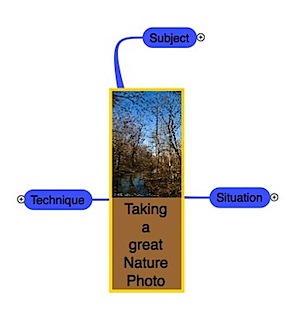
It seems simple when stated…a good technique + a photogenic subject + wonderful situation = stunning photograph. But if simple, consider hundreds of thousands of amateur and professional photographers are taking thousands of shots and still only produce a fairly limited number of nature photos considered stunning.
Let’s consider these elements in more detail.
I put together the diagram below to illustrate how many variables are available within each of the three key elements. (It’s meant to illustrate the complexity of these three elements, not to be a complete and accurate index, so please view with an open mind.)
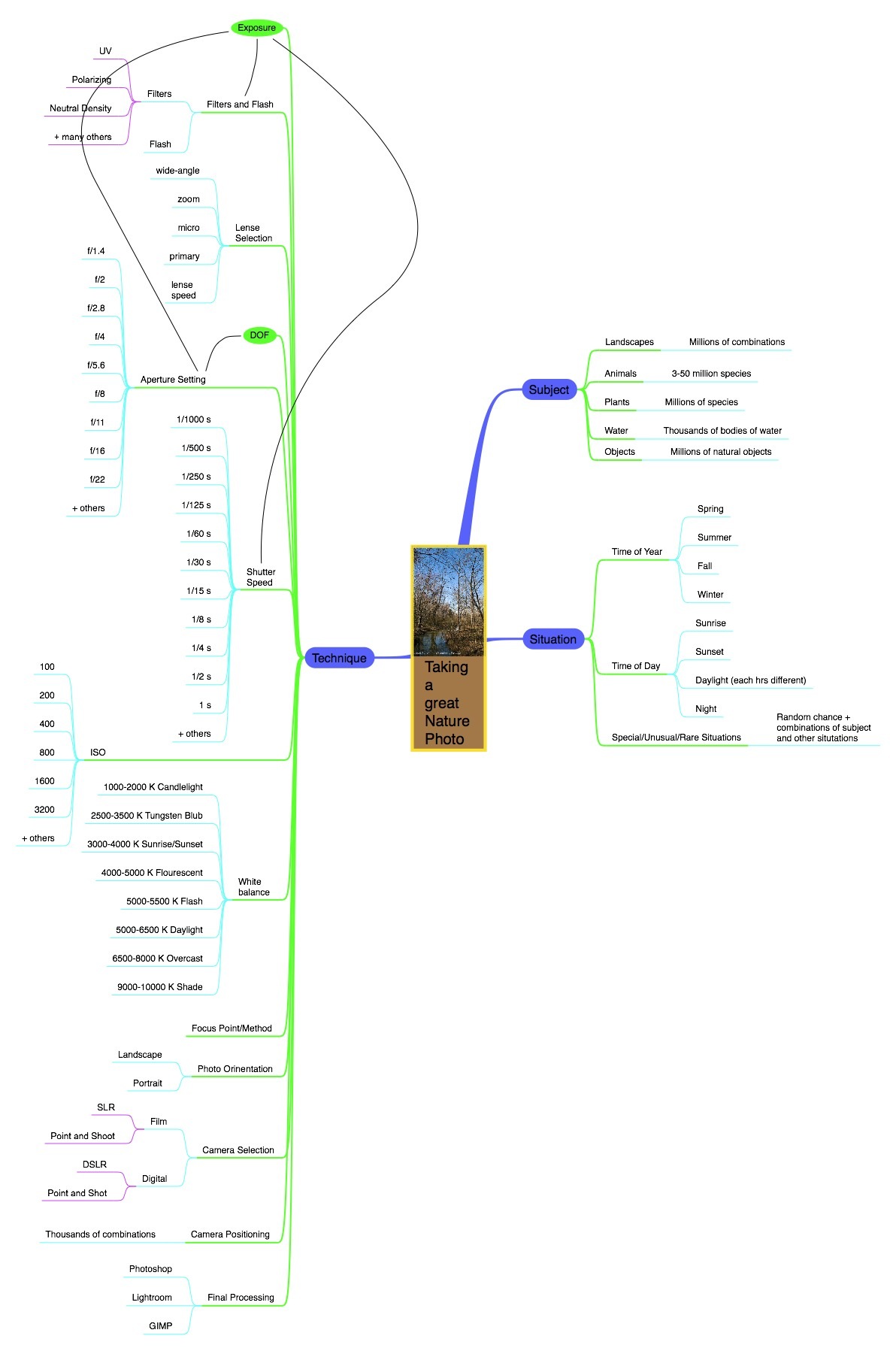
Humm…not so simple. There’s an almost unlimited number of variables that can go into any shot. There’s no wonder that almost every shot is unique and why thousands of people can take photos of basically the same thing and each of them be different.
— For me, this is part of the beauty of the art of photography. —
Don’t be discouraged or overwhelmed by this complexity because there’s also many different combinations that will produce an outstanding photo. With experience you’ll shorten the list of combinations down to those you know work well together and produce effects that you like. Then you’ll just have to find the best ones for the particular circumstance.
This relates to a recent discussion by Paul Lester I read on working the shot.
The premise is that if you find a subject that calls your attention for some reason, make sure that you give it your attention. My implementation of it is that I donât just shoot one or two shots and then move on. I work the shot. Try it from every conceivable angle that I can think of, even if I think it is silly.
You may vary the technique while keeping a selected subject and a stable situation, as Paul describes or if your subject allows, you may vary the situation perhaps by returning at different times of the day or year as described by Paul Butzi. You may even use a combination of methods.
In simple terms, working the shot is varying one or more of the three elements: technique; subject; or situation, in an effort to produce a “better” photo.
The best method is the one that works for you and you don’t have to worry that there’s only one way to take good nature photographs, there’s many…that’s the nature of nature photography. :-)
Perhaps there is a different way to approach the complexity — instead of thinking of the nearly infinite combinations possible with lenses, apertures, subjects, etc., it makes more practical sense to eliminate the elements that are not appropriate for the effect you want to produce. I though of Sherlock Holmes’s approach to visual accuity:
“On the contrary, Watson, you can see everything. You fail, however, to reason from what you see. You are too timid in drawing your inferences.”
Our job as photographers is not to produce every conceivable perspective about a subject but to relate an emotional / visual effect that we most clearly glean from observing a subject. I guess it could be asserted that this is a minimalist view of the subject but I would assert that it is more an approach of clarification.
Just some food for thought…
Rich:
Excellent point and in principle I agree.
My thinking is that process of elimination of “those elements that are not appropriate for the effect you want” must be based upon experience and knowledge, and how are we to gain this experience?
A novice will not truly know what effect each variable gives unless they experiment. Even a professional should push their boundaries and comfort zone at times in pursuit of better art.
Those complicated things we do every day become simple to us.
Thanks for the comment.
Excellent post, Earl. I love the charts and graphs! If I had known that photography was so complex, I would have taken up needle stitch!!! :-) I’m glad that I have a simple mind. Now, I’m all confused!!!
Paul:
Confused…Not! LOL
You may have been great at needle stitch, but the photographic community is better for you being here. ;-)
You’ve been in photography long enough for it to be almost automatic for you.
Not so for the novice. The same would go for programming or any technical activity…maybe even needle stitch! :-)