Anyone who owns a Nikon DX camera has hear of the 1.5 magnification/crop factor. This crop factor is the ratio of the dimensions of a camera’s imaging area compared to a reference format. The reference format is most often the 35 mm film format or what is called Full Frame (FX) in Nikon digital camera lingo.
The crop factor as described by Ken Rockwell:
If a photo is made with the same lens, but a smaller sensor, it shows a smaller area.
This is why it’s called a crop factor. The smaller sensor is cropping the lens’ image compared to a 35mm film frame. Ditto for what you see through the viewfinder…
…Nothing changes about the lens; it’s simply the amount of the image we get from the back of the lens.
Paul Lester stated in a recent comment that he would love to see two pictures taken from the same spot with the same lens using a D700 and D300 camera. It sounded like an interesting project so I set my tripod up on a cement walkway and proceeded to take two sets of photos using the same 20 mm, 50 mm and 105 mmm prime lenses on both cameras.
All the photos were shot from the exact same spot with the focal point being the first Crape Myrtle tree just to the right of the white mail box at the end of the driveway. The photos have not been post-cropped or altered in any way.
20 MM:
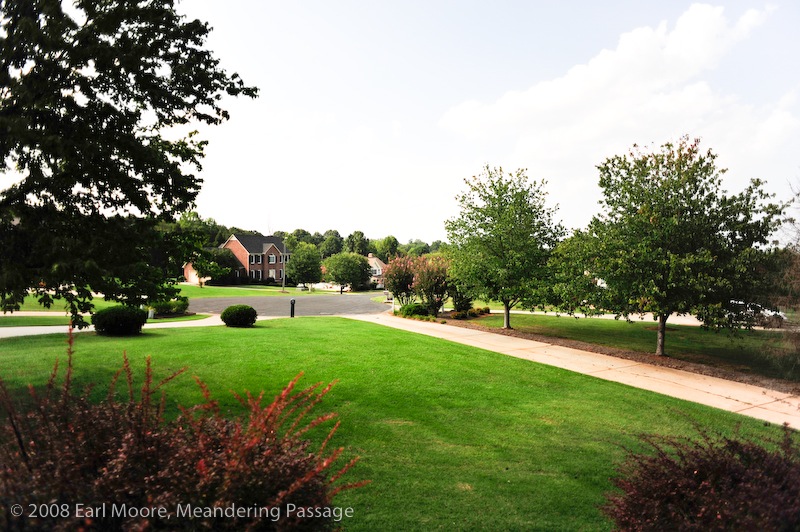
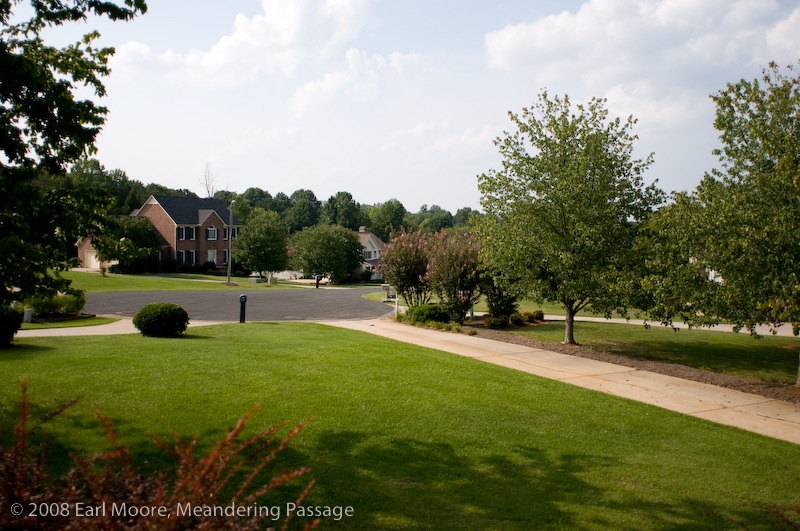
50 MM:
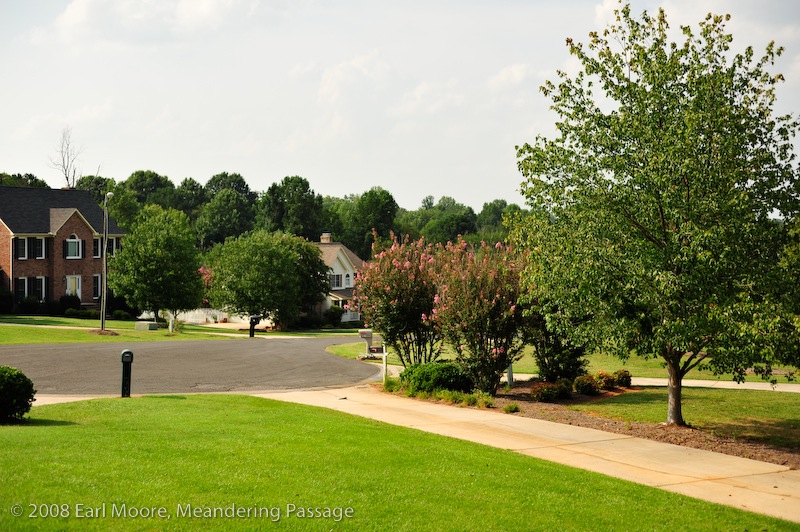
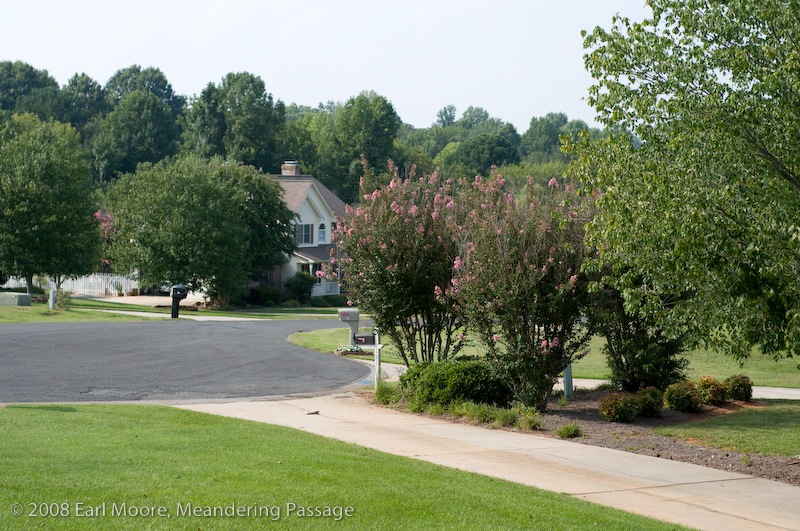
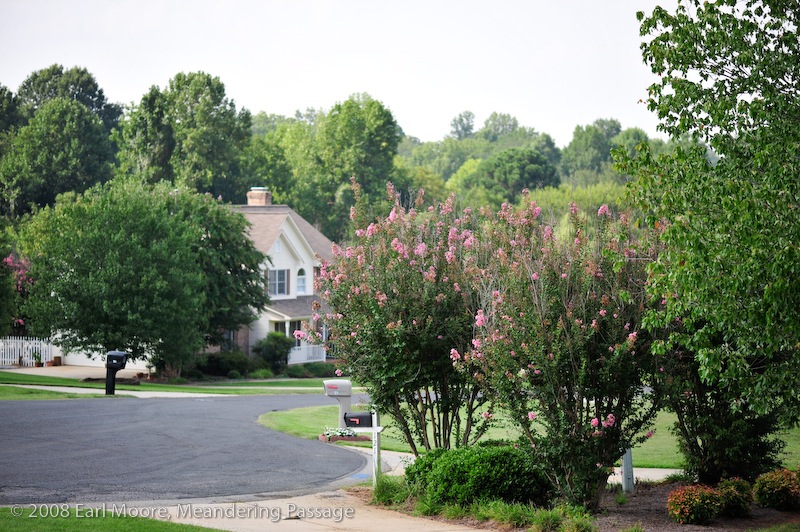
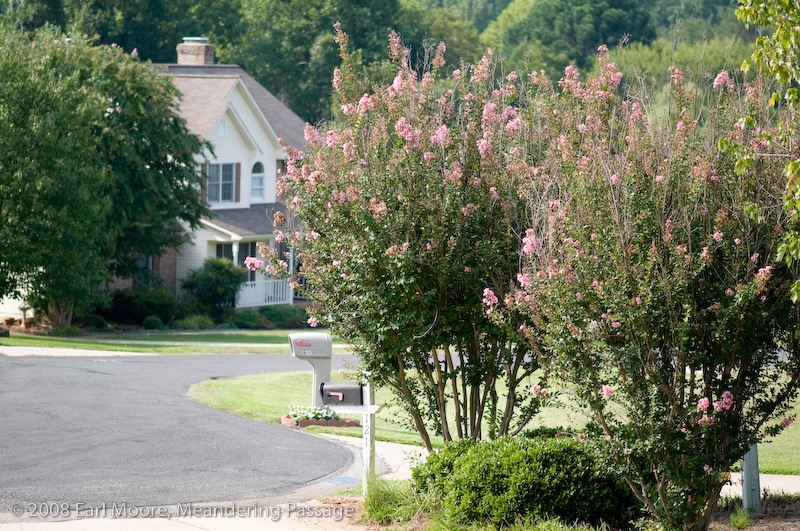
You’ll notice that the D300 photos appear to be cropped compared to the wider field of view (FOV) the D700 provides at the same lens focal length.
There also appears to be a magnification factor with the D300 photos. How can this be if the lens produces the same magnification no mater what camera it’s attached to? The image produced on the small-sensor DX (D300) will be enlarged more to produce output (print or screen) that matches the output of a longer focal length lens on a full-frame/FX (D700) camera. This “enlargement” is a internal system magnification not a true lens magnification but the result is somewhat the same.
In situations where you’re shooting wildlife and need the highest magnification possible you may want to consider the D300 as you’ll be able to get more magnification with a shorter and less expensive focal length lens.
That’s one reason I’m keeping my Nikon D300. It has it’s advantages and is a complimentary companion for the Nikon D700.
You read about the magnification/crop factor of DX cameras but it’s still interesting to view the differences for yourself.
Note: The color mode on the D700 was set to Vivid while the D300 was set to Normal. This accounts for the slightly higher color saturation in the D700 photos.
Much thanks, Earl. So there is a magnification and it is readily apparent in all three photos. Interesting. The magnification makes sense, now. Thanks!
@Paul: I enjoyed seeing the results first hand as well. The magnification factor/effect actually becomes more pronounced as the lens focal length becomes longer.
For a Nikon DX with a 20mm lens the magnification factor results in only about 10mm more relative focal length, but with a 105mm lens the magnification factor accounts for an additional 52mm. When you get up to 400-600mm lenses it can become a sizable (200-300mm) increase.
I also noticed that the color saturation of the D700 seems to be higher; however, this could be the effect of having the color modes set differently.
@Paul: You’re exactly right, the D700 was set for Vivid and the D300 was set Normal. I didn’t catch that until after the fact when I viewed the photos.
Hey,
What you didn’t say was whether there is a difference of field of view also, if you were to use a dx lens with a dx sensor. Important!
@Angel: Hi. A DX lens or a non-DX lens of the same focal lenghts on a DX Camera (smaller sensor) would give the same results. I say this from what what I’ve read and from my own experience shooting with a DX camera using both DX and non-DX lenses. I noticed no difference in when switching FOV between these lenses.
For testing above I used my prime lenses which are non-DX.
Of note, a DX lens on a Full Frame (FX) camera (large sensor) will result in only part of the sensor being used and a smaller image total pixel count (less than 6mp compared to a normal 12mp+.)
So what’s the advantage of a DX lens? Well, in most cases for the same focal length the cost will be less for a DX lens then a non-DX lens due to to it’s design and construction. They’re designed so manufacturers can offer more affordable lens for DX camera users, resulting in more sales. But, if you think a full frame (FX) camera is in your future you’d be better off in the long run to buy only non-DX lenses.
Earl, I came across this page whlst Google-researching the “long reach” advantage of DX over FX. You seem to be the only person in the world who thought of posting comparison shots taken with the same lens! I’d be very interested in seeing full-rez crops of details from both cameras, to compare sharpness, detail, etc.
@Jack: Glad you found this comparison interesting. It’s difficult presenting the sharpness, detail, etc. your looking for on a web site while insuring the cropping and conversions don’t skew the results. There’s also factors I didn’t control when I took the original shots such as insuring both camera’s were in perfect focus on “exactly” the same spot.
Just from my experience from shooting with both cameras/formats now for a number of months, both are capable of excellent sharp photos.
Hi Earl,
I am a 65 year old novice with a Nikon D70 and would like to upgrade and I am considering the D300 and D700 for the purpose of bird photography. I was thinking of the D300 as the correct choice but can’t get my head around DX & FX.
I have a 70-200 FX lens and 2xconverter.
What would be your personal choice.
@Brian Breach: I was online so you’re getting a quick response. :-)
Both are great cameras, but if you’re going to do bird photography I’d recommend the D300 for the reason of the 1.5 DX magnification factor. On your D70 and a D300, your 70-200 lens is the equivalent of a 105-300 mm lens on a FX camera. In other words, to have the same magnification/crop factor on a FX D700 camera as you currently do, you’d need to purchase a longer (and usually more expensive) lens.
The areas where the D700 shines is in shooting either wide angle or low light.
I use both cameras and I always pick the D300 for wildlife shooting because for the same lens I can get closer and therefore usually better photos.
Regards
Hi Earl,
First GREAT comparison! Actually the only one on the inet that I could find. I have spent a lot of time recently researching. Thank you. I have been shooting 35mm for 15+ years and recently made the switch from a N90 to a D300. My question for you is “Does the field of view through the camera change or is just what is captured by the sensor that is cropped (specifically when shooting a FX lense on a DX body)?” I have both DX and old FX (35mm) lenses and I can’t “see” a difference through the viewfinder.
Thank you in advance!
Adam
You almost got it right except you Can’t enlarge the DX photo and say its bigger. I can do that with ant photo. Call the tech guy at Nikon.
Pat, thanks for your comment but I think you missed the point. These photos were demonstrating field of view and how the D300 with it’s smaller sensor has a relative narrower field of view making it similar to having a longer focal length lens when photos are displayed at the “same size”. They both came from 12mp camera’s so both photos were resized equally for this post.